A service account signs in from a new country at 2:40 a.m. on a Saturday and starts pulling files. The log records it. Nobody reads that log until Monday.
A managed SOC exists to close that gap. Mandiant’s M-Trends 2026 found that the median time between initial access and hand-off to a second threat group fell to 22 seconds in 2025. IBM’s 2026 data puts the average time to identify and contain a breach at 247 days.
This guide explains what managed SOC services are, what they include, how they work and what they cost. It also shows how to compare managed SOC providers before you sign a contract, including the response terms most brochures skip.
What Is Managed SOC?
A managed SOC is a security operations center run by an outside provider. Its analysts monitor your environment, investigate suspicious activity, and escalate or help contain real threats under a service agreement, usually around the clock.
SOC managed services extend or replace an internal security team, so a business gets continuous monitoring without hiring and scheduling a full team.
The terms overlap. Managed SOC as a service, SOC as a service, and SOC as a service usually describe the same subscription model. A SOC managed service can range from monitoring only to full response.
What a SOC Actually Does
A security operations center combines people, processes, and tools to monitor security events. Analysts typically work with three kinds of tools:
- SIEM: Security information and event management platforms collect and correlate logs.
- EDR or XDR: Endpoint and extended detection and response tools show activity on devices and across systems.
- SOAR: Security orchestration, automation, and response tools run routine steps automatically.
The tools create signals. The analysts decide what those signals mean.
SOC Is Not SOC 2
The acronym causes real confusion. A SOC is a team and a function, while SOC 2 is an AICPA audit framework for service organizations.
A provider can run a SOC without holding a SOC 2 report, and a company can hold a SOC 2 report without having a SOC. Ask about each one separately.
Why Managed SOC Matters Now
Attackers now move faster than most teams can staff for, and breaches keep getting more expensive. These figures show why many mid-sized businesses look for outside help with continuous monitoring.
- Breach cost: The global average reached $4.99 million in 2026, a 12% increase and a record high, according to IBM.
- Dwell time: The global median rose to 14 days from 11, according to Mandiant.
- Entry points: Verizon’s 2026 DBIR found that 31% of breaches began with vulnerability exploitation, and 48% involved a third party.
- Skills: 59% of cybersecurity professionals reported critical or significant skills needs, up from 44% in 2024, according to ISC2.
- SOC staffing: The SANS 2025 SOC Survey found that 79% of SOCs run 24/7, and 2 to 10 people is the most common size for a fully staffed SOC.
A log nobody reads until Monday is a real exposure when dwell time is measured in days and hand-offs in seconds.
What Managed SOC Services Include
Scope varies by provider, so treat this list as a checklist and confirm each item. A complete service covers six functions, from watching events to documenting what happened afterward.
24/7 Security Event Monitoring
A 24/7 managed SOC watches events from endpoints, identities, networks, cloud platforms, and applications at all hours. Confirm that coverage means live analysts at night and on weekends, and not only automated alerting.
Alert Triage and Investigation
Analysts review alerts, discard false positives, and work out what happened. Good triage gives your team a short list of real incidents with context, which reduces alert fatigue.
Threat Detection and Tuning
Detection rules need steady adjustment as the environment changes. The provider writes and tunes use cases, often mapped to the MITRE ATT&CK framework, so new applications and user behavior neither flood the queue nor slip past it.
Threat Intelligence and Hunting
Threat intelligence adds context about known attacker infrastructure and techniques. Threat hunting searches for activity that never triggered an alert. Some providers include hunting, and others charge for it separately.
Incident Escalation and Response
This is where services differ most. Some providers only notify you. Others isolate hosts, disable accounts, or block traffic under pre-approved rules. Ask which actions they take themselves and which stay with your team.
Reporting and Compliance Evidence
Reports should show what was monitored, what was found, and what changed. Retained logs and incident records can support audits against frameworks such as ISO 27001, although the compliance obligation stays with your business.
How a Managed SOC Works
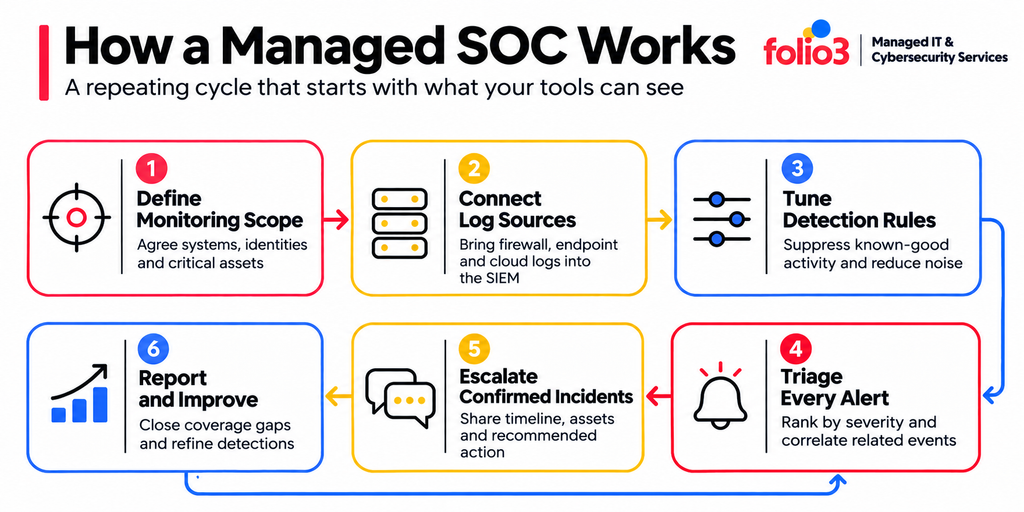
A managed SOC runs as a repeating cycle after a setup phase. The first steps decide how useful the service becomes, because analysts can only investigate what their tools can see.
Step 1: Define Monitoring Scope
The business and provider agree which systems, identities, cloud accounts and applications are in scope. They also rank assets across the wider IT infrastructure, so an alert on a domain controller outranks one on a test laptop.
Step 2: Connect Log Sources
Logs from firewalls, endpoint tools, Microsoft 365 and cloud platforms flow into the SIEM. Every missing source becomes a blind spot, so the provider should document coverage.
Step 3: Tune Detection Rules
Early alert volume is usually noisy. Analysts learn what normal looks like and adjust rules to suppress known-good activity. This work repeats whenever the environment changes.
Step 4: Triage Every Alert
Analysts classify each alert by severity, correlate it with related events, and investigate anything suspicious. Runbooks keep this work consistent across shifts.
Step 5: Escalate Confirmed Incidents
Confirmed incidents go to the agreed contact with a timeline, the affected assets and a recommended action. Containment then follows the response authority set out in the contract.
Step 6: Report and Improve
Regular reviews cover incidents, coverage gaps, and rule changes, and they fit naturally into a monthly IT review. A good managed SOC provider uses each incident to improve detections, so the same attack path is harder to repeat.
Managed SOC Delivery Models
The right model depends on how much of the work your team wants to keep. Most arrangements take one of three shapes, and the difference comes down to who handles which tasks and shifts.
Fully Managed SOC Model
In a fully managed SOC, the provider runs monitoring, triage, tuning and escalation end to end. This suits businesses with small IT teams and no dedicated security analysts.
Co-Managed SOC With Internal Teams
The provider and internal staff share the work. Your team often keeps response decisions and investigations on sensitive systems, while the provider handles alert volume. This suits companies that have security staff but need more capacity.
After-Hours SOC Coverage Model
Internal analysts cover business hours, and the provider takes nights, weekends and holidays. The handover needs clear rules, because open investigations must move between teams without losing context.
Managed SOC vs In-House SOC
An in-house SOC gives you more control and deeper business context, while a managed SOC gives you coverage sooner. For many mid-sized businesses, the staffing math settles the question.
A week has 168 hours. At 40 hours per person, one analyst seat needs 4.2 full-time staff before leave, sickness, or training. Two analysts on every shift doubles that to 8.4.
| Factor | In-house SOC | Managed SOC |
| Time to coverage | Slower: hire, train, and build process | Faster: the team and process already exist |
| 24/7 staffing | At least 4 full-time staff per seat | Covered by the provider’s shifts |
| Business context | Deep | Must be taught and kept current |
| Data and tool control | Full | Depends on the contract |
| Cost structure | Salaries, tools, storage, and training | Subscription based on scope |
| Best fit | Organizations that can fund a full team | Small and mid-sized teams that need coverage |
Managed SOC vs Similar Services
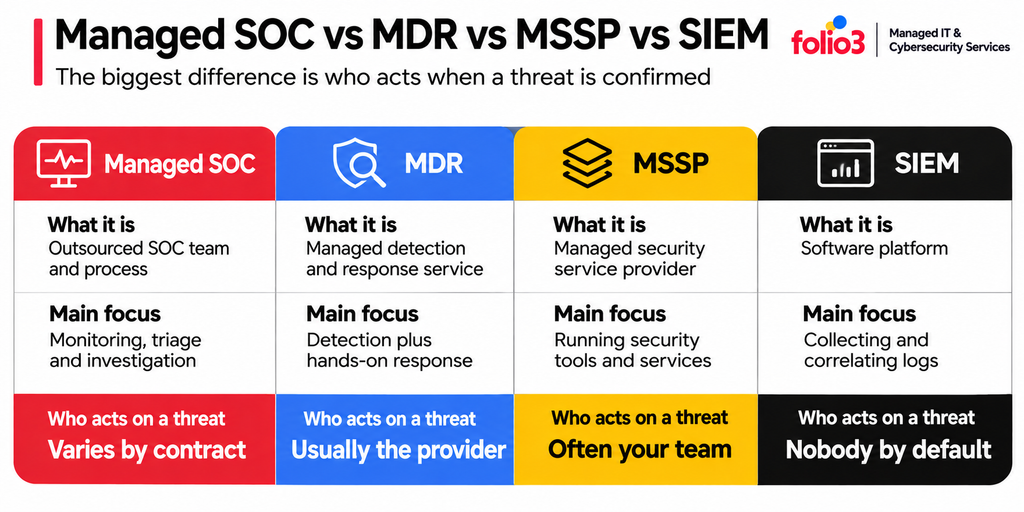
Vendors use these labels loosely, and they overlap in practice. Compare what each option actually does, especially who acts when a threat is confirmed, because that decides how far an attack gets.
| Option | What it is | Main focus | Who acts on a threat |
| Managed SOC | Outsourced SOC team and process | Monitoring, triage and investigation across the environment | Varies by contract, from escalation to containment |
| MDR | Managed detection and response service | Detection plus hands-on response, often built around EDR or XDR | Usually the provider, within agreed rules |
| MSSP | Managed security service provider | Running security tools and services, such as firewalls | Often your team, after a notification |
How AI Changes Managed SOC
AI now handles a growing share of repetitive SOC work, including enrichment, alert grouping, and first-pass summaries. It speeds up the queue, but an accountable analyst still needs to make judgment calls.
- Good fit for automation: Gathering context, grouping related alerts and drafting incident timelines.
- Needs a person: Scoping a breach, disabling an executive’s account and explaining business impact.
Ask providers which steps are automated and how analysts check AI output. Your own AI tools matter here too, since they add new activity that needs security monitoring.
Who Needs a Managed SOC
A managed SOC service provider makes the most sense when the need for coverage outgrows the team available to deliver it. These situations are the most common triggers.
- No overnight coverage: Alerts wait until someone logs in the next morning.
- Small IT teams: Alerts land with generalists who already have a full workload.
- Compliance pressure: Customers or auditors expect log review and incident records.
- Cloud and remote growth: Business growth adds identities, devices and events faster than teams can review them.
- Too many tools: Several security platforms run with nobody correlating their alerts.
A managed SOC is a poor first purchase if the basics are missing. Sort out vulnerability management, identity and access management and tested backups first, because monitoring tells you about problems without preventing them.
Limitations of Managed SOC
Outsourcing monitoring does not outsource accountability. Every managed SOC has limits, and they are easiest to handle in contract terms before go-live, while you can still negotiate.
- Less business context: A provider cannot know about a quarter-end batch job or an executive’s travel until someone tells them.
- Escalation delays: Without authority to act, an analyst can only call. If nobody answers at 3 a.m., the attacker keeps moving.
- Data access: Confirm that you can search and export your logs during the contract and after it.
- Tool dependence: A managed SOC provider that runs its own SIEM may leave you with no detections when the contract ends.
- Retained responsibility: Customers and regulators still hold your business responsible for the outcome of an incident.
Choosing Managed SOC Providers
Managed SOC providers often look alike on a website, so the real differences show up in contract terms and live tests. Three areas reveal the most before you sign.
Agree Response Authority Early
Decide before go-live who may act, and on what. This example shows the level of detail worth writing down.
| Action | Provider | Your team |
| Isolate a workstation | Acts under a pre-approved rule | Informed |
| Disable a standard user account | Acts under a pre-approved rule | Informed |
| Disable an executive or admin account | Recommends | Approves |
| Isolate a production server | Recommends | Decides |
| Notify customers or regulators | Supplies evidence | Decides |
SLA Metrics Worth Measuring
Ask for these metrics in writing, along with how each one is measured. A provider that clocks acknowledgement may still call it response.
- Mean time to acknowledge (MTTA): How quickly an analyst picks up an alert.
- Mean time to detect (MTTD): How long malicious activity runs before it is found.
- Mean time to respond (MTTR): How long containment or handover takes after detection.
- False positive rate: The share of escalations that turn out to be harmless.
- Log source health: How quickly the provider notices that a source has gone silent.
Questions for Managed SOC Providers
- Are analysts on shift at 3 a.m., or only on call?
- Which response actions do you take without asking us?
- Which log sources are included, and which cost extra?
- Can you work with our existing security tools?
- Who owns the logs and detection rules when the contract ends?
- Where is our data stored, and who can see it?
- Can we see a redacted incident report?
- Will you run a simulated attack before we commit?
How Folio3 Supports Security Monitoring
Folio3’s SOC services cover 24×7 security monitoring, SIEM monitoring and use-case management, threat detection and alert triage, log monitoring and correlation, and security incident escalation. The service runs remotely and complements your existing IT or security team, with the monitoring scope agreed during onboarding.
For deeper investigation, Folio3’s managed detection and response service adds threat hunting and coordinated response. Both sit within a wider managed security practice, and Folio3 holds ISO/IEC 27001 certification. The ActiveComply case study shows security monitoring and remediation working alongside an internal team during SOC readiness.
Buy Outcomes, Not Alerts
A managed SOC puts trained analysts on your environment during the hours your own team is offline. Its value depends on details a brochure rarely covers: which logs are connected, who can act and how quickly.
Start with the coverage you lack, then decide how much response authority you are willing to hand over. Test the service against a realistic scenario before you rely on it.
The label on the contract matters far less than what happens at 2:40 a.m. on a Saturday.
Frequently Asked Questions
A managed SOC is a security operations center run by an outside provider that monitors, investigates and escalates threats for your business. It gives you continuous coverage without building a full internal team.
In cybersecurity, SOC stands for security operations center, the team that monitors for threats and responds to them. In chip design, the same letters mean system on a chip, and SOC 2 is a separate audit framework.
A managed SOC focuses on broad monitoring, triage and escalation across your environment, while MDR adds hands-on response. Many SOC managed services now include some containment, so compare the actions each provider actually takes.
A 24/7 managed SOC monitors the agreed endpoints, identities, networks, cloud platforms and applications at all hours. Confirm that analysts are on shift overnight and that the response actions are written into the contract.
Published vendor ranges run from about $50 to $200 per user per month, or $8 to $30 per endpoint per month. The final price depends on coverage hours, log volume and response scope.
No, it usually complements internal IT or security staff by taking on continuous monitoring and alert triage. Your team still owns business decisions, system changes and final accountability.
Compare analyst coverage, response authority, log ownership and measured SLAs. Then run a simulated attack, because a test shows more than a sales demo.