
IT problems become harder to manage as a business grows. Support requests increase, cybersecurity risks expand and become harder to control, and leadership needs clearer visibility into technology decisions.
That is where IT Management Services help.
IT Management Services cover the ongoing support, security, monitoring, maintenance, and strategic planning of a business’s technology environment. Instead of only fixing issues when something breaks, a managed IT partner helps prevent problems, reduce risk, and keep systems aligned with business goals.
What Are IT Management Services?
IT Management Services help businesses manage their users, devices, networks, platforms, cybersecurity, backups, applications, and IT strategy through one structured service model.
For many companies, this means working with a Managed Services Provider, or MSP, that acts as an extension of the internal IT team. The MSP handles day-to-day support, infrastructure management, cybersecurity, operations, reporting, and long-term technology planning.
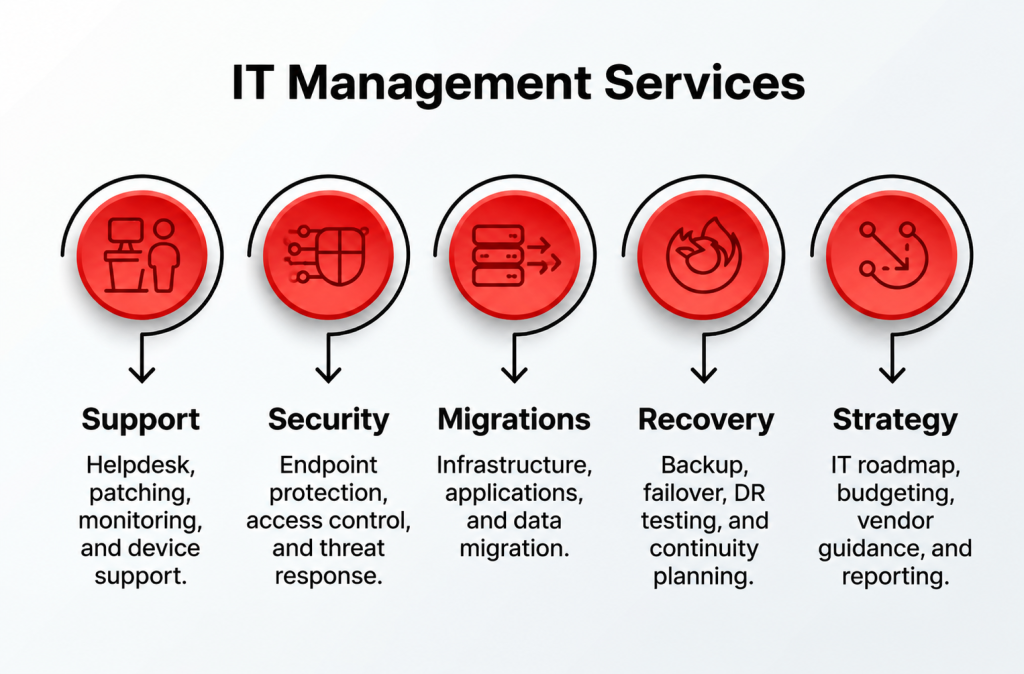
A complete IT management model usually brings several core services together under one managed approach:
It starts with Managed IT Support, which covers day-to-day helpdesk assistance, patching, system monitoring, asset tracking, vendor coordination, and reporting. This helps keep users productive and ensures recurring IT issues are handled before they create larger disruptions.
- Cybersecurity Management protects the business across endpoints, networks, users, environments, and data. This includes endpoint protection, firewall management, SOC monitoring, phishing protection, incident response, and security controls that reduce exposure to cyber threats.
- Migration services cover servers, operating systems, applications, databases, email, data, storage, networks, directory environments, virtual workloads, and tenant consolidation, with dependencies and post-move validation built into the plan.
- IT Strategy & vCTO Services give leadership a clearer technology direction through IT roadmaps, budgeting, vendor guidance, digital transformation planning, and executive-level reporting.
- Network & Infrastructure Management supports the systems that keep the business connected, including LAN, WAN, SD-WAN, Wi-Fi, firewalls, routing, switching, and infrastructure monitoring.
- Disaster Recovery & Business Continuity help protect operations from outages, ransomware, accidental deletion, and system failures through backup management, recovery planning, failover readiness, ransomware recovery preparation, and DR testing.
- VoIP Services support business communication with VoIP setup, call routing, user management, monitoring, troubleshooting, and ongoing support.
- Database Management helps maintain performance, reliability, and security across SQL and NoSQL through backup, tuning, monitoring, access control, and issue resolution.
- Identity & Access Management secures user access across business systems with MFA, SSO, privileged access management, Active Directory support, access reviews, and identity governance.
Where Reactive IT Support Starts to Break Down
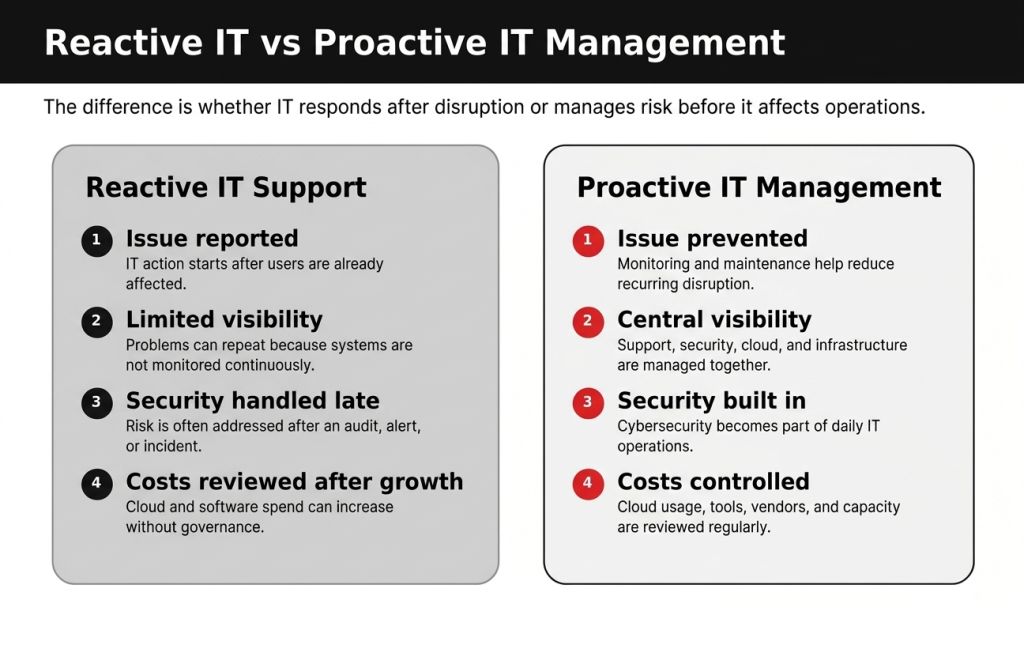
Reactive IT support follows a familiar pattern:
- A user experiences a problem, reports it, and waits for someone to investigate. The issue is resolved after productivity has already been affected.
- This model can work when a business has a small number of employees and a simple technology environment. It becomes less effective as the organization grows.
- More users create more support requests. Additional applications introduce more dependencies. Cybersecurity risks increase. Vendor contracts and software licences become harder to track.
- Eventually, the IT team spends most of its time responding to immediate problems, leaving little time for monitoring, security improvements, documentation, recovery testing, or long-term planning.
Why Businesses Need IT Management Services
Basic IT support is often reactive. A user reports a problem, IT investigates it, and the issue gets fixed after disruption has already occurred. That approach does not scale well.
Growing businesses need proactive IT management because technology affects productivity, security, compliance, customer experience, and operational continuity.
| Business Problem | Folio3 IT Management Solution | Business Impact |
| Frequent downtime | Proactive monitoring and maintenance | Fewer disruptions |
| Slow user support | Managed helpdesk and escalation | Faster issue resolution |
| Security gaps | Cybersecurity management and access control | Lower risk |
| Weak backup planning | Disaster recovery and business continuity | Faster recovery |
| Poor IT direction | IT strategy and vCTO support | Better technology decisions |
Managed IT Support
Managed IT Support keeps users, devices, and systems running with helpdesk support, remote and on-site assistance, patch management, device monitoring, asset tracking, vendor coordination, and monthly reporting.
This helps reduce recurring issues, improve user experience, and give businesses a clear support structure for daily IT operations.
- Cybersecurity Management
Cybersecurity Management protects users, endpoints, networks, and business data through endpoint detection, firewall and VPN management, phishing protection, security awareness training, SOC monitoring, incident response, and compliance support.
Cybersecurity should be part of daily IT operations, not a separate afterthought. . For growing organizations, guidance from CISA’s small and medium business security resources can also support stronger protection across users, systems, and data.
- Migration Security & Readiness Assessment
Migration work covers servers, operating systems, applications, databases, email, data, storage, networks, directory environments, virtual workloads, and tenant consolidation, with dependencies and post-move validation built into the plan.
- IT Strategy & vCTO Services
IT Strategy & vCTO Services give businesses executive-level technology guidance without hiring a full-time CIO or CTO.
This includes IT roadmaps, budgeting, infrastructure planning, digital transformation guidance, vendor selection, risk reviews, and board-level technology reporting. The goal is to make sure technology investments support business outcomes instead of becoming disconnected expenses.
- Network & Infrastructure Management
Network & Infrastructure Management keeps business systems connected, secure, and stable. This includes LAN and WAN management, SD-WAN, wireless networking, firewall management, routing, switching, monitoring, and multi-site connectivity support.
A reliable network improves productivity, reduces outages, and helps secure business operations across offices, remote teams, and branch locations.
- Disaster Recovery & Business Continuity
Disaster Recovery helps businesses prepare for outages, ransomware, hardware failure, accidental deletion, and other disruptions.
This includes backup management, recovery planning, ransomware recovery preparation, failover readiness, business continuity planning, and DR testing. A strong recovery plan should also align with practical business continuity planning so critical operations can continue during disruption.
- Additional IT Management Services
IT management also includes specialized services that support communication, applications, data, and access security.
VoIP Services support call routing, user setup, monitoring, troubleshooting, and ongoing communication support.
Database Management covers SQL, NoSQL, including backup management, performance tuning, monitoring, access control, and issue resolution.
Identity & Access Management helps secure user access through MFA, SSO, privileged access management, Active Directory support, user access reviews, account lifecycle management, and identity governance.
How Folio3 Helps
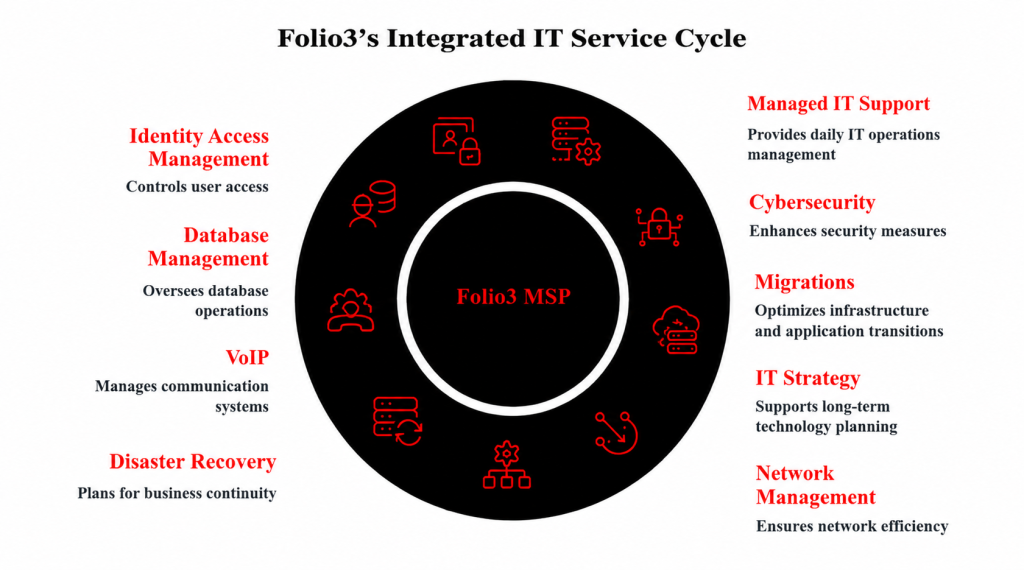
Folio3 brings managed IT support, cybersecurity, IT strategy, network management, disaster recovery, VoIP, database management, and identity access management into one MSP service model.
Instead of working with disconnected vendors, businesses get one partner to manage daily IT operations, improve security, optimize infrastructure, and support long-term technology planning.
Final Thoughts
IT Management Services help businesses move from reactive IT support to proactive technology management. They reduce downtime, improve security, and infrastructure costs, strengthen recovery planning, and give leadership better visibility into IT.
For growing businesses, the right MSP partner can make technology easier to manage, easier to secure, and easier to scale.
Frequently Asked Questions
IT Management Services cover the ongoing support, monitoring, maintenance, security, optimization, and strategic planning of a business’s IT environment.
Basic IT support usually focuses on fixing issues after they occur. IT Management Services are more proactive and include monitoring, maintenance, cybersecurity, cloud management, infrastructure support, reporting, and strategic planning.
Yes. Growing businesses often need reliable IT support, stronger security, cloud management, and technology guidance without having to build a large internal IT department.
Yes. Folio3 supports on-premises and hybrid environments across users, devices, infrastructure, applications, networks, security, and backup systems.
Yes. Folio3 helps strengthen cybersecurity through endpoint protection, SOC monitoring, firewall management, phishing protection, access control, incident response, and compliance-focused support.
The first step is a free consultation. Folio3 reviews your current IT environment, identifies gaps, and recommends the right management approach based on your business needs.
Folio3 provides managed IT support, cybersecurity management, cloud security,, IT strategy and vCTO support, network and infrastructure management, disaster recovery, VoIP services, database management, and identity access management.