
A migration can finish successfully on Friday night and still create a difficult Monday morning.
Users can sign in. Data is in the right place. The application passes its technical checks. The project tracker shows every migration task as complete. Then the first support requests arrive, and a different set of questions appears.
Who owns the new alerts? Which team handles application access? Has the recovery procedure been updated? Are the temporary migration accounts still active? Does the service desk know where to escalate an integration failure? Can somebody outside the project team explain how the new environment actually works?
These are operational questions, and they are one reason professional services in IT should be judged by more than whether the technical implementation worked.
Good project delivery prepares the environment for the people who will operate it long after the project engineers move on. Scope, testing, documentation, security cleanup, monitoring, recovery, support procedures, and ownership all have to reach the finish line as well.
The difference becomes obvious a few weeks after go-live.
Project Success Needs a Better Finish Line
Most technology projects naturally focus on the change itself. A migration team cares about moving workloads. An identity project concentrates on permissions and authentication. A network project is measured against connectivity and performance requirements.
Those are reasonable measures, but they only describe part of the outcome.
The ISO/IEC 20000-1 service management standard places planning, design, transition, delivery, and ongoing improvement within the service lifecycle. That is a useful frame for project work because the system being delivered eventually becomes somebody else’s day-to-day service.
IBM describes IT service management in a similar way, covering the planning, implementation, management, and optimization of technology services throughout their lifecycle.
A project therefore has two important milestones. The first is when the technical change works. The second is when the environment can be supported without depending on the people who implemented it.
The second milestone is easier to overlook.
The Scope Should Describe What Operations Receives
Project scopes often describe technical activity clearly.
Move 200 users to a new tenant. Replace a firewall. Migrate an application. Introduce a new identity platform. Consolidate two environments after an acquisition.
The scope becomes more useful when it also defines the operational end state.
PMI has repeatedly connected weak requirements management with poor project outcomes. Its research on requirements management and project success found that inaccurate requirements contributed materially to unsuccessful projects, particularly where scope, communication, and stakeholder involvement were weak.
Operational requirements deserve the same attention as technical ones.
Before the project begins, somebody should be able to answer questions such as:
| Project question | Why it matters later |
| Who owns the new service? | Support and escalation need an accountable team |
| Which monitoring must be active? | Operations needs visibility once the project closes |
| Which access is temporary? | Migration permissions should not quietly become permanent |
| What documentation is required? | Future engineers need to understand the environment |
| How will recovery work? | Backup and DR procedures may change with the architecture |
| Who approves the final result? | Technical completion and business acceptance are different checks |
| What happens after go-live? | Hypercare and support responsibility need clear boundaries |
This is where professional services in IT can add much more value than simply supplying engineers for a change window.
The project can be designed around the environment the customer needs to operate afterward.
Operations Should Be in the Room Before Go-Live
A common project mistake is introducing the operations team during handover.
By then, most important technical decisions have already been made.
The application architecture is set. Administrative roles have been created. Monitoring choices have been made. Network paths exist. Backup arrangements may already be configured. If the receiving team identifies an operational gap at this stage, fixing it can mean reopening project work that was supposedly complete.
AWS’s current operations readiness guidance treats the future operating model as part of migration preparation. It distinguishes different operating approaches and connects operations readiness with the way environments will actually be managed after transition.
Its broader operations integration guidance recommends reviewing runbooks, support processes, SLAs, backup strategies, operational responsibilities, training needs, success metrics, and post-implementation reviews before the environment is considered production-ready.
That makes sense even outside AWS projects.
The team that will receive the pager should have some say in what triggers it.
Cutover Plans Need to Describe Failure Too
Most cutover documents describe the sequence when everything works.
That is the easy version.
A useful plan also deals with an application that will not start, a database that takes longer to synchronize than expected, users who cannot authenticate, an integration that stops passing data, or a DNS change that behaves differently from testing.
AWS recommends including contingency planning, rollback procedures, dependencies, testing, owners, task sequencing, downtime expectations, and operational changes within a pre-cutover plan.
Its cutover guidance goes a step further by recommending predefined rollback checkpoints and a named person who can decide whether the team should fix forward or reverse the change.
Those details matter.
“Roll back if necessary” leaves the hardest decision until everyone is already under pressure.
A proper rollback plan states what triggers the decision, how much time reversal requires, what happens to newly created data, which changes need to be reversed, and how users will be informed.
The rollback path deserves almost as much attention as the deployment path.
Change Management Should Match the Risk
A password-policy adjustment and a full tenant migration should not pass through identical change processes.
Their risk is completely different.
Atlassian’s IT change management guidance separates changes into standard, normal, and emergency categories. Standard changes are generally repeatable and low-risk, while normal and emergency changes receive different levels of assessment according to their impact and urgency.
ServiceNow approaches the same issue through formal planning around impact, rollout, backout, roles, downtime, approval, and implementation. Its IT change management overview makes backout planning part of the change process rather than something invented after a failed implementation.
For professional services in IT, this matters because many projects create high-impact production changes.
The process should provide enough control to protect the service without burying engineers in paperwork that adds no useful information.
Handover Should Prove That Someone Else Can Run the Service
A one-hour knowledge-transfer meeting is not strong evidence that a handover worked.
The project engineer understands the environment because they have spent weeks or months building it. The receiving team has diagrams, notes, and perhaps a recorded call.
Those are very different levels of understanding.
A more useful handover lets the receiving team perform normal operational tasks while the project team is still available.
Can they locate the correct logs? Can they identify the application owner? Do they know what normal performance looks like? Can they safely restart a service? Do they know which alerts require immediate escalation? Can they find the recovery procedure?
IBM describes IT operations as the work of implementing, managing, delivering, and supporting IT services against business needs.
That gives project handover a practical test.
Can the receiving team actually manage and support what has been delivered?
Documentation Should Describe Production, Not the Original Plan
Most technology projects create plenty of documentation.
The problem is that documentation ages surprisingly fast.
The original design shows one network path. Testing forces another. An integration behaves differently than expected. A security requirement introduces another component. The final architecture ends up slightly different from the design approved six months earlier.
None of that is unusual.
Leaving the old diagram as the official record is.
Configuration management exists partly to solve this problem. IBM’s configuration management overview describes configuration information and dependency tracking as a way to understand system state and make safer technology changes.
The final handover should therefore describe the environment that exists now.
Useful operational documentation usually includes architecture, dependencies, ownership, administrative access, monitoring, recovery, vendor contacts, known exceptions, routine procedures, and outstanding work.
A beautifully formatted design document that describes an environment nobody actually built has limited operational value.
Temporary Project Access Needs an Expiry Date
Projects create exceptions.
Migration engineers may receive elevated access. Vendors may need temporary administrative accounts. Security policies might be relaxed during testing. Firewall rules can be widened. Service accounts are created quickly because a dependency needs to be validated before cutover.
Most of these decisions are reasonable during delivery.
They become a problem when nobody revisits them.
Project closure should include an access review covering privileged roles, temporary identities, test accounts, vendor access, firewall exceptions, security exclusions, and administrative credentials.
Some access will remain because operations needs it.
Some should disappear because the project has ended.
That distinction is easier to make while everyone still remembers why the access was created.
Hypercare Gives Early Problems Somewhere to Land
The first few days after a significant implementation generate information that no test environment can fully reproduce.
Real users behave differently. Production integrations process real volumes. Scheduled jobs begin running against live data. Support requests reveal confusion that technical testing never captured.
Hypercare gives the project team a defined period to observe that behavior before normal ownership fully takes over.
AWS includes a hypercare period among the operational areas organizations should prepare for during larger migrations. Its guidance places hypercare alongside security, support models, administration, backup, and migration cutover.
The useful part is defining what hypercare actually means.
For one project it may involve three days of elevated monitoring. For another, it could mean two weeks of daily incident reviews, application checks, integration validation, and direct project-engineer escalation.
There should also be an exit condition.
A fixed date is convenient, but service stability is a better measure. If a supposedly seven-day hypercare period reaches day seven while a major integration still fails every night, the project is not operationally ready simply because the calendar says so.
Support Tickets Are Useful Project Data
A project team can learn a lot from the service desk during the first week.
Ten employees asking where a feature moved may point to weak communication. Several failed logins could indicate a group or access-policy problem. Repeated reports of slow performance from one office may reveal a dependency that testing missed.
Those tickets should be analyzed together rather than treated only as separate support requests.
IBM’s problem management guidance describes the distinction between incidents and their underlying causes: related incidents can point to a broader problem that needs root-cause investigation.
That principle works particularly well during project hypercare.
One ticket may be noise.
Twenty-five similar tickets after go-live are evidence.
The project team should still be close enough to the work to investigate that evidence while design decisions are fresh.
Monitoring Needs an Owner Before the Project Closes
Monitoring is not complete when the dashboard exists.
Somebody has to know what the signals mean and what action follows.
A database alert may need immediate escalation. Another could be informational. A failed integration might require an application owner rather than infrastructure support. A capacity warning could become a planned task instead of an incident.
ITSM provides a useful structure for this because service management connects monitoring and operational processes with incident, change, problem, and service ownership. IBM’s ITSM overview specifically describes standardized processes around requests, support, change, and service delivery rather than treating monitoring as an isolated technical function.
This is another reason operations belongs in project design.
Project engineers know what the new system can report.
Operations knows which signals somebody will actually respond to.
Security Exceptions Should Leave With the Project Team
Temporary exceptions have an inconvenient habit of becoming permanent configuration.
A firewall rule remains open. A migration administrator keeps a privileged role. An endpoint exclusion is never removed. A test account survives because nobody is sure whether an integration still depends on it.
This can happen even when the original project followed good security practices.
The closure process needs its own cleanup.
The receiving team should know which exceptions were deliberate, which remain necessary, who accepted them, and when they will be reviewed. Temporary access should be removed rather than simply documented and forgotten.
This is where project completion and ongoing cybersecurity operations meet.
The security posture after the project matters more than the security posture during the project plan presentation.
Recovery Documentation Has to Move With the Architecture
Projects change environments.
Recovery plans have to follow those changes.
An application that moved to new infrastructure may have a different backup schedule, different dependencies, different credentials, and a completely different recovery sequence. A tenant consolidation can alter identity dependencies. A network redesign can change how users reach a recovery environment.
AWS’s cutover guidance includes backup, validation, rollback, operational changes, and post-cutover testing as part of migration planning rather than treating them as separate concerns.
The operational question is straightforward:
If this service fails next month, does the recovery procedure describe the environment we have now?
If the answer depends on the original project engineer remembering what changed, the handover is unfinished.
Professional Services in IT Should Reduce Future Dependency
There is a useful way to test project quality six months later.
Can another engineer understand the environment?
Can they see its dependencies, find the documentation, identify the owner, make a routine change, and understand how recovery works without calling the original project team to reconstruct the design?
If they can, the project left behind something maintainable.
If every change still starts with “ask the person who built it,” the organization has inherited another operational dependency.
PMI describes transition requirements as the capabilities required to move an organization from the current state to the desired future state and actually use the new solution effectively.
That is a useful way to think about professional services in IT.
The work includes the transition into a usable operating model, not merely the technical implementation.
Where Project Work Turns Into Managed IT
Professional services and managed services solve different parts of the technology lifecycle.
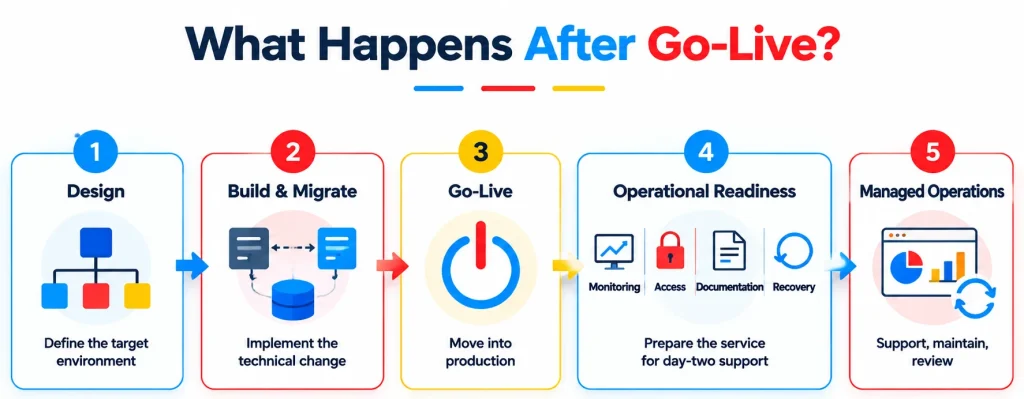
Project teams design and implement changes. Managed operations take responsibility for keeping the resulting environment usable afterward.
| Project delivery | Managed operations |
|---|---|
| Assessment and design | Monitoring |
| Implementation | Ongoing administration |
| Migration | User and system support |
| Cutover | Incident management |
| Initial testing | Maintenance |
| Technical validation | Performance review |
| Documentation | Documentation upkeep |
| Recovery design | Recovery testing |
| Handover | Service ownership |
The boundary should be planned from the beginning.
IBM’s ITSM guidance treats service design, transition, operation, and continual improvement as connected parts of service management.
That is much healthier than throwing a completed project “over the wall” and hoping operations can make sense of it.
How Folio3 Connects Technical Projects With Ongoing IT Management
Folio3’s current managed IT services model covers managed IT support, cybersecurity management, migration, IT strategy & vCTO, network & infrastructure management, disaster recovery, databases, and identity & access management.
That wider operating scope becomes useful after a major IT project because the resulting environment usually crosses several technical disciplines.
Managed IT Support
A project may finish, but employees will continue interacting with the changed environment every day.
Folio3’s Managed IT Support includes proactive helpdesk, patching, monitoring, and vendor coordination. That gives post-project user issues an operational path once hypercare ends.
The support desk can also reveal patterns that deserve deeper technical investigation rather than treating every ticket independently.
Cybersecurity Management
Projects frequently change permissions, endpoints, applications, network paths, and administrative access.
Folio3’s cybersecurity offering covers endpoint protection, firewall controls, phishing, SOC monitoring, incident response, and access management across the environment.
That creates an ongoing place to review the security state after temporary project exceptions and migration accounts have been removed.
Migration Services
Folio3 migration work covers servers, operating systems, applications, databases, email, data, storage, networks, directory environments, virtual workloads, and tenant consolidation, with dependencies and post-move validation built into the plan.
Network & Infrastructure Management
New applications and migrations can change the routes employees, offices, and third-party systems use to reach business services.
Folio3’s Network & Infrastructure services cover LAN, WAN, SD-WAN, Wi-Fi, firewalls, routing, switching, and performance monitoring.
That gives post-project connectivity issues somewhere to be investigated beyond the implementation team’s original network diagram.
Disaster Recovery
Changes to infrastructure should trigger changes to recovery.
Folio3’s Disaster Recovery and Business Continuity offering includes backup management, failover readiness, DR testing, and defined RTO/RPO commitments.
A project handover is stronger when recovery reflects the new production environment rather than the architecture that existed before the project began.
IT Strategy & vCTO
Some project findings belong on a roadmap rather than inside the current scope.
A migration may expose an aging application. A network project can reveal inconsistent branch standards. An identity engagement may uncover a larger governance problem.
Folio3’s IT Strategy & vCTO service includes technology roadmaps, budgeting, risk reviews, vendor decisions, and executive reporting.
That gives unfinished but legitimate findings somewhere to go without quietly expanding the current project forever.
The Best Project Leaves Operations With Fewer Questions
Go-live gets attention because it is visible.
The better measure appears later.
Monitoring is working. The support desk knows where incidents go. Documentation reflects production. Temporary access has disappeared. Recovery procedures match the new architecture. The receiving team can perform normal administration without waiting for the engineer who built everything.
That is what a useful handover looks like.
Professional services in IT can make that transition deliberate by designing operational readiness into the project itself. Requirements include day-two needs. Cutover planning includes rollback. Documentation follows the final architecture. Hypercare has an owner and an exit condition. Managed operations know exactly what they are receiving.
The project eventually ends. The service has to keep working.
Frequently Asked Questions
Operations should be involved before implementation decisions are finalized. The receiving team can identify requirements around monitoring, support, recovery, documentation, access, escalation, and service ownership that may affect the technical design.
A usable handover usually includes the final architecture, dependencies, ownership, administrator procedures, monitoring, escalation paths, backup and recovery information, vendor contacts, known exceptions, and outstanding work. The receiving team should also have enough practical knowledge to operate the service.
There is no useful standard period for every project. A small configuration project may need little or no formal hypercare, while a migration affecting hundreds of users and several integrations can justify a longer period. Exit criteria based on service stability are more useful than choosing a date alone.
Projects involving meaningful production risk should have a defined contingency approach where rollback is technically possible. AWS recommends documenting rollback procedures, checkpoints, decision ownership, and data considerations before a migration cutover begins.
Knowledge transfer gives the receiving team information. Handover transfers actual responsibility. A good handover should therefore confirm that operations can use the documentation, respond to alerts, perform routine tasks, and escalate correctly.
They should be reviewed once the tasks requiring them are finished. Some may still be needed during hypercare, but unnecessary privileged access should have a defined removal point rather than remaining open indefinitely.
Yes. The advantage is that operational requirements can be included earlier in the project and the receiving team can understand the environment before handover. The project scope and recurring managed-service responsibilities should still be clearly separated.