
Most companies know which applications they consider important. Far fewer know exactly what should happen when one of those applications disappears at 10:30 on a working morning.
Finance may still need to release payments. Customer service needs access to account information. Employees need a way to communicate. IT needs to determine whether the incident affects one application, an entire environment, or the identities administrators use to begin recovery.
That is where continuity planning becomes practical rather than theoretical.
Business continuity consulting services help businesses decide what must keep operating during disruption, what can wait, which systems and people critical processes depend on, and how recovery should work when normal operations are unavailable.
The goal is not to prepare only for one type of event. Ransomware, infrastructure failures, power problems, application errors, and natural disasters can all interrupt normal operations in different ways.
ISO 22301, the international standard for business continuity management systems, takes the same broad view. It covers planning, implementation, operation, monitoring, review, maintenance, and ongoing improvement of continuity arrangements rather than treating continuity as a single recovery document.
A useful plan should answer one simple question: How does the business keep its most important work moving when normal systems are not available?
Start With the Business Process, Not the Backup Platform
Continuity planning often starts in the wrong place.
IT opens the infrastructure inventory and begins listing servers, virtual machines, applications, databases, and backup jobs. Those assets matter, but the business does not experience disruption as a server problem. It experiences an inability to invoice customers, approve payments, process orders, communicate with employees, or deliver a service.
That changes the order of the work.
Suppose an ERP platform supports purchasing, inventory, and customer orders. Restoring the application server will not restore the business process if the database remains unavailable, employees cannot authenticate, or the warehouse has lost connectivity.
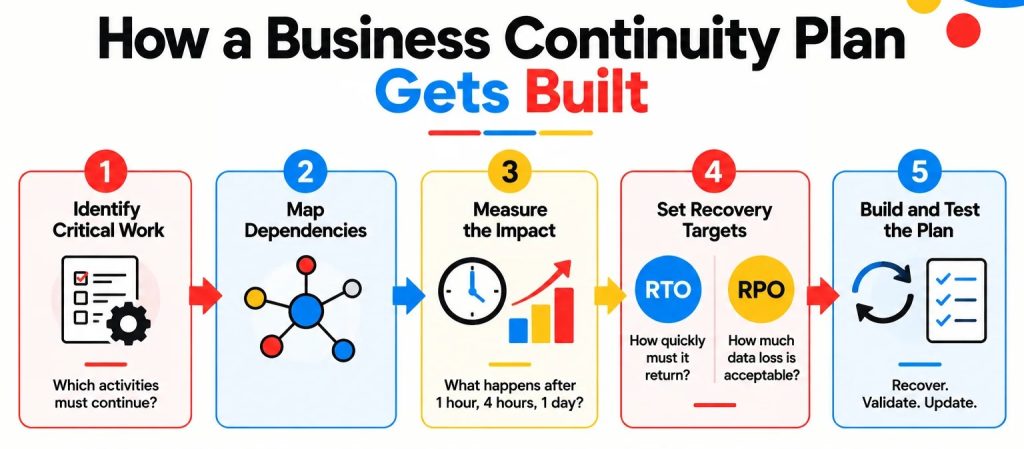
A proper continuity review starts with the activity and follows its dependencies downward.
The Business Continuity Institute’s Good Practice Guidelines use Business Impact Analysis (BIA) and risk assessment to understand business continuity requirements. BCI describes the BIA as a way of examining the effects of disruption over time so organizations can establish recovery priorities and resource requirements. That produces a much better question than “Which servers should we restore first?”
Ask instead: Which business activity becomes unacceptable if it remains unavailable for two hours, eight hours, or a full working day?
A Business Impact Analysis Forces Real Priorities
Almost every application owner believes their application is critical.
That is understandable. Their team depends on it.
The problem appears when every system receives the same priority. If twenty applications are all labelled “Priority 1,” the business still has no recovery sequence when several of them fail together.
A Business Impact Analysis forces those priorities into the open.
It looks at what happens as downtime continues. The effect might be lost revenue, missed regulatory commitments, delayed customer service, payroll disruption, contractual penalties, operational backlog, or an inability to perform another process.
DRI International places BIA and risk assessment before continuity-strategy selection in its professional practices. Its framework then moves into continuity strategies, incident response, plan development, testing, crisis communication, and maintenance.
This prevents the recovery plan from becoming a technical popularity contest.
A customer-facing transaction platform might need rapid restoration. An internal reporting environment could tolerate a longer interruption. Payroll may have moderate recovery requirements during most of the month but become far more time-sensitive near the payroll deadline.
Context matters.
RTO and RPO Turn Expectations Into Recovery Requirements
“Get us back online quickly” is not a technical requirement.
Neither is “We cannot lose much data.”
Continuity planning needs measurable targets.
- Recovery Time Objective (RTO) defines the maximum acceptable time a service can remain unavailable.
- Recovery Point Objective (RPO) defines how much recent data loss the business can tolerate when recovering.
AWS uses RTO and RPO as the central objectives for disaster-recovery planning and recommends setting them according to business requirements before selecting a recovery architecture. Its guidance also stresses that the recovery approach should be tested against those objectives.
Consider an order-management platform. If the business sets an RTO of 30 minutes, the recovery design has to support restoration within that window. If its RPO is 15 minutes, the backup or replication strategy has to limit potential data loss accordingly.
Those numbers allow engineers to design something that can actually be tested.
Business Continuity and Disaster Recovery Need Each Other
Business continuity and disaster recovery are often used as though they mean exactly the same thing.
They are closely connected, but the distinction is useful.
A Business Continuity Plan focuses on how critical business activities continue or resume during disruption. A Disaster Recovery Plan focuses more specifically on recovering the technology and data supporting those activities.
IBM makes this distinction in its business continuity versus disaster recovery guidance. IBM describes BCPs as broader plans for returning business functions to normal, while DR plans concentrate more closely on protecting and recovering IT systems and critical data.
Take a ransomware incident.
The technical recovery might involve isolating compromised systems, validating backup data, restoring workloads, re-establishing administrator access, and checking whether applications are safe to return to production.
The continuity plan has a different set of questions. Can Finance still make an urgent payment? How will employees communicate while primary systems are unavailable? Who decides which services return first? Who communicates with customers?
Both plans need to meet at the same point.
Recovery technology without an operating plan leaves the organization waiting for IT. A business plan without working recovery technology eventually runs out of alternatives.
Dependency Mapping Finds the Things Nobody Thinks About
Critical applications rarely stand alone.
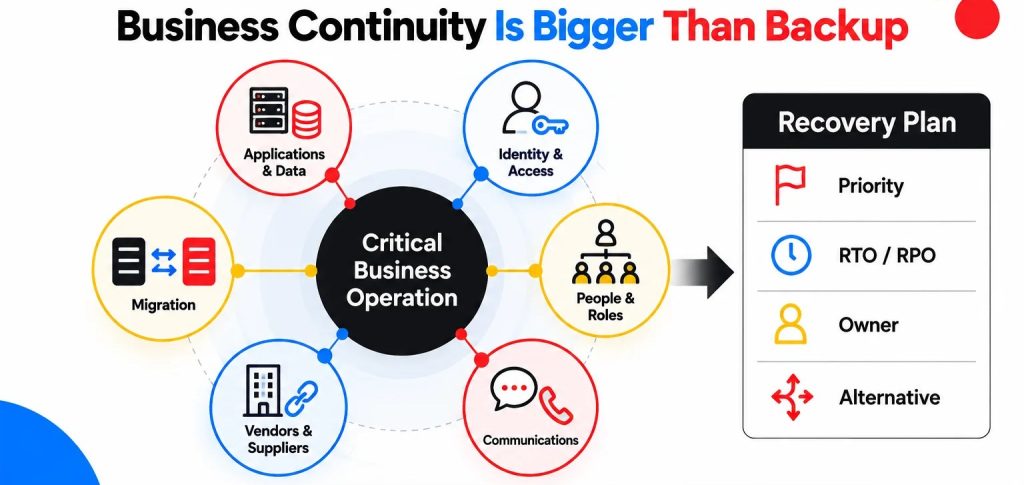
A customer portal might depend on DNS, an identity service, a database, an API, an email platform, a network connection, and a third-party payment service. The portal itself can be fully restored and still remain unusable if one of those dependencies is missing.
This is why continuity planning needs dependency mapping.
A continuity assessment should identify the services each business activity requires, which third parties are involved, how users authenticate, where the data sits, and which connections have to exist before the workflow is genuinely operational again.
This is usually where the uncomfortable discoveries appear.
The backup server uses the same administrative credentials as production. The alternative office depends on the same telecom provider. A critical SaaS product has only one administrator. A supposedly independent recovery environment still relies on the production identity platform.
Finding these problems during planning is inconvenient.
Finding them during recovery is much worse.
Third-Party Services Belong in the Continuity Plan
Modern companies depend on providers they do not control.
That includes SaaS applications, internet carriers, payment services, logistics partners, payroll systems, banking platforms, and outsourced technology providers.
A critical business process may depend on three or four of them.
This means supplier continuity deserves more than a vendor spreadsheet. The business should understand which processes depend on each provider, whether alternatives exist, what the provider has committed to contractually, and what employees can still do if that service becomes unavailable.
DRI’s professional practices explicitly include third-party providers when identifying continuity strategies and also call for coordination with external organizations during response and recovery.
One supplier supporting several critical processes deserves a different level of attention from a supplier supporting an internal convenience tool.
That distinction should appear in the continuity plan.
Backups Are Useful Only When Recovery Works
Backup dashboards are reassuring.
They can also create false confidence.
A green status tells you that a backup process completed. It does not prove that the complete business service can be restored within the required RTO, with data falling inside the required RPO.
IBM’s disaster-recovery guidance makes this distinction clearly: backups are an essential part of DR, but backup and recovery alone do not make a complete disaster-recovery plan. DR also involves planning, technology, failover, and ongoing testing. IBM’s disaster recovery overview explains the wider scope.
A useful recovery test therefore needs to go beyond restoring one file.
- Can the application connect to its database?
- Can users authenticate?
- Are certificates valid?
- Do integrations reconnect?
- Does DNS send traffic to the correct environment?
- Can the business process actually resume?
AWS’s Well-Architected Framework specifically recommends testing disaster-recovery implementation to validate that it meets the defined objectives.
Backup success is an input.
Business recovery is the outcome.
Ransomware Changes the Recovery Question
Hardware failure and natural disasters are difficult, but cyber incidents add another problem: the organization may not immediately trust its own environment.
A ransomware event can affect administrative accounts, production workloads, backup systems, network services, or data. Recovery therefore has to consider whether the systems and backups being restored are clean, whether the credentials used to recover them remain trustworthy, and whether the recovery environment is sufficiently separated from the affected systems.
This makes ransomware recovery planning different from a straightforward hardware replacement.
A technically available backup is not enough if the recovery team cannot safely determine what should return to production.
Recovery planning should therefore include clean recovery points, administrator access, recovery sequencing, validation, isolation where appropriate, and practical exercises that test how the team responds when the production environment itself cannot be trusted.
People and Communication Belong in the Plan Too
Technology is only part of the recovery process.
A building can become inaccessible while all systems remain operational. Key employees can be unavailable. A communications outage can affect one location. A third-party incident may prevent an external team from providing the support the recovery plan expects.
A continuity plan needs alternative people and decision routes for these situations.
DRI includes training, awareness, crisis communications, and external coordination within its professional practices because recovery depends on people knowing what they are expected to do.
The communication plan deserves particular attention.
If email and Microsoft Teams are unavailable, how does the incident-response team communicate? If the company website is down, where are customer updates published? If the emergency contact list sits in the affected system, who has an accessible copy?
A plan becomes much more useful once it answers these awkward questions.
Testing Exposes What the Document Cannot
A continuity plan can look excellent in a document and still fail quickly in an exercise.
Names change. Passwords expire. Recovery instructions become outdated. A third-party portal requires an MFA device nobody thought to include. An application that was restored successfully six months ago now depends on another system.
Testing finds these gaps while there is still time to correct them.
The Business Continuity Institute places exercising and validation within the continuity lifecycle, while DRI calls for an ongoing program of plan exercise, assessment, and maintenance.
Different tests answer different questions.
A tabletop exercise checks decision-making, responsibilities, and communications. A backup-restore test checks whether protected data can be recovered. A failover test checks whether services can move to the recovery environment. A broader DR drill can test whether several teams can restore a complete service within the required timeline.
The more important the business process, the less useful it is to rely on assumptions.
A Good DR Drill Should Make the Team Make Decisions
Consider a realistic scenario.
At 8:30 a.m., the IT team detects suspicious activity affecting several privileged accounts. At 9:00 a.m., the primary environment is isolated while the investigation continues. Finance has a critical payment run at noon, and customer-facing systems are becoming unavailable.
What happens next?
Which person has authority to invoke the continuity plan? Can the recovery team use its normal administrative accounts? Which service returns first? Does Finance have a temporary process? Who communicates with employees and customers? When does leadership get an updated recovery estimate?
Those decisions are difficult enough when everyone is sitting in a calm meeting room.
During a real incident, uncertainty costs time.
Regular drills help turn the response from improvised conversation into a process the team has already practiced.
Business Continuity Consulting Services Should Leave the Business With Something Usable
A continuity engagement should produce more than a policy document.
The organization needs an agreed understanding of its critical activities, technical and third-party dependencies, recovery objectives, existing gaps, recovery procedures, responsibilities, and testing schedule.
That work can include a Business Impact Analysis, continuity plan, recovery requirements, dependency mapping, DR procedures, communication arrangements, and testing.
ISO 22301 treats business continuity as a maintained management system with ongoing monitoring, review, maintenance, and improvement.
That matters because continuity requirements move with the business.
A new ERP system changes dependencies. A merger introduces another set of applications and users. An office move changes network requirements. A new SaaS product might become part of a critical workflow. A major security change can alter administrative access during recovery.
The plan needs to move with those changes.
How Folio3 Supports Business Continuity and Disaster Recovery
For Folio3, the focus is on making recovery measurable, validated, and tested before the business has to depend on it.
Your Business Continuity Is Our Priority
When systems fail through ransomware, infrastructure failure, or a natural disaster, recovery speed and data protection become operational concerns immediately. Folio3’s business continuity and disaster recovery services are designed around defined recovery commitments, validated backups, documented continuity planning, and regular testing.
Folio3’s Business Continuity and Disaster Recovery offering includes:
- <15-minute average recovery time objective
- Automated daily backup validation
- Business Continuity Plan (BCP) development
- Defined RTO and RPO commitments
- Ransomware recovery planning and testing
- Regular DR drills and failover testing
Each of these addresses a different weakness that often appears in continuity planning.
Automated Daily Backup Validation
A scheduled backup should not be assumed successful simply because the job was configured correctly.
Daily validation provides a recurring check that backup activity is being completed as expected and helps identify failures before an actual recovery request exposes them.
AWS recommends testing and validating disaster-recovery implementation rather than assuming the presence of backups is sufficient.
On-Site and Off-Site Backup Solutions
Different failure scenarios require different protection options.
A local copy can help with rapid recovery from an isolated failure, while off-site or hosted copies can provide protection when the primary location or environment is affected. The right combination depends on workload importance, recovery targets, and the type of disruption being planned for.
Business Continuity Plan Development
Technology recovery needs a documented business response around it.
Folio3’s Business Continuity Plan development helps establish how critical services should be prioritized and how recovery responsibilities, procedures, and dependencies fit together during disruption.
This connects directly with ISO 22301’s approach to continuity as a managed, maintained process rather than a single recovery task.
Defined RTO and RPO Commitments
Recovery requirements become useful when they are measurable.
Folio3 defines RTO and RPO commitments so recovery expectations can be tied to the systems and data the business depends on.
Folio3 states an average recovery time objective of under 15 minutes for its disaster-recovery offering.
The exact requirements still need to reflect the workload. A Tier 1 customer-facing system and a low-priority internal application do not necessarily need identical recovery targets.
Ransomware Recovery Planning and Testing
Ransomware recovery needs its own planning because the source environment may itself be untrusted.
Folio3 includes ransomware recovery planning and testing so teams can work through the sequence before a real event: identify usable recovery data, understand dependencies, determine recovery priority, and verify the recovered service.
Testing matters here because the challenge is not simply restoring files. The recovered environment has to be usable and trustworthy.
Regular DR Drills and Failover Testing
A recovery plan is stronger when the people responsible for executing it have already used it.
Folio3 includes regular DR drills and failover testing to check whether documented procedures, technical recovery, and recovery targets still work as expected.
This aligns with AWS’s recommendation to test DR implementations and DRI’s requirement for ongoing continuity-plan exercises, assessment, and maintenance.
A failed drill is useful information.
It gives the business a chance to fix the problem before a real outage turns it into downtime.
Continuity Planning Should Reduce the Number of Decisions Made During an Outage
The best continuity plans do something fairly simple: they remove uncertainty.
Teams already know which services matter most. RTO and RPO targets have been agreed. Dependencies have been documented. Backups are being validated. Recovery procedures exist. People know who makes decisions, and the recovery process has been tested.
That preparation changes the first few hours of an incident considerably.
Instead of debating what should happen, the business can begin executing what was already agreed.
This is where business continuity consulting services provide their real value. They give the organization time to identify gaps and make decisions while normal operations are still available.
ISO 22301, BCI, DRI, AWS, and IBM approach the subject from different angles, but they converge on a similar idea: continuity depends on understanding business impact, setting recovery requirements, documenting how recovery works, and testing those assumptions before disruption.
Folio3’s continuity and disaster-recovery services build on that operational need through daily backup validation, multi-location backup options, BCP development, defined RTO/RPO commitments, ransomware recovery planning, and regular DR and failover testing.
Frequently Asked Questions
No. Business continuity deals with keeping critical business activities operating through disruption, while disaster recovery focuses more specifically on restoring IT systems and data. IBM treats DR as a related but more technology-focused part of the wider continuity process.
Start with business impact rather than technology capability. Identify how long the process can remain unavailable and how much recent data can be lost before the impact becomes unacceptable, then design recovery around those requirements. AWS and Google Cloud both recommend this approach.
No. A successful backup confirms that data was copied; it does not prove that the complete service can be restored. Applications, databases, access, connectivity, integrations, and recovery procedures may all need to work before the business can resume operations.
Frequency should reflect the importance of the workload and how often the environment changes. DRI calls for an ongoing program of plan exercises, assessment, and maintenance rather than treating testing as a one-time event.
Ransomware can affect the same production systems, credentials, and data that teams normally rely on during recovery. The recovery process therefore needs to consider which recovery points are safe, how access will work, what returns first, and how the restored environment will be validated.
Yes. Recovery requirements should follow business impact. AWS specifically recommends choosing DR strategies according to application criticality and the RTO/RPO required for each workload rather than applying the same recovery design everywhere.
Folio3’s offering includes an average RTO under 15 minutes, automated daily backup validation, on-site/off-site backup options, BCP development, defined RTO and RPO commitments, ransomware recovery planning and testing, and regular DR drills and failover testing.