
A business can spend heavily on technology and still end up with applications that do not communicate, data migration costs nobody can explain, security tools that are poorly configured, and projects that stall halfway through.
Buying another platform will not solve that kind of problem. Someone needs to examine the current environment, identify what is getting in the way, compare the available options, and turn the decision into a realistic plan.
So, what is technology consulting?
Technology consulting is the process of helping an organization assess, plan, improve, and manage the technology that supports its work. A technology consultant may review IT strategy, applications, networks, cybersecurity and SaaS environments, migrations, costs, vendors, data protection, and disaster recovery.
The work begins with a business question. The technology comes after it.
What Is Technology Consulting in Practical Terms?
When business leaders ask, “What is technology consulting?”, they are often trying to work out whether they need advice, implementation support, ongoing IT management, or all three.
A technology consultant studies how the company currently operates and where technology is creating cost, delay, risk, or unnecessary manual work. The consultant then recommends a course of action based on evidence from the existing environment.
IBM describes technology consulting as work focused on optimizing IT infrastructure and delivering technology solutions that improve operational efficiency. In practice, the scope can extend from one defined project to a wider technology roadmap.
A consulting engagement might answer questions such as:
- Why are SaaS costs increasing?
- Which security gaps should be corrected first?
- Can the current network support another office?
- How should two Microsoft 365 tenants be consolidated after a merger?
- Which systems need to be recovered first after an outage?
- Is a proposed application compatible with the current environment?
- Which IT projects should receive budget this year?
The answer should be more useful than “buy this product.” Good consulting explains the problem, the options, the trade-offs, the expected cost, and what must happen next.
What Does a Technology Consultant Actually Do?
A technology consultant does not spend the entire engagement writing strategy documents.
The work usually involves reviewing technical evidence, speaking with business and IT stakeholders, mapping dependencies, identifying risk, comparing options, and translating the findings into decisions that management can act on.
Examines the Current Environment
The consultant first needs an accurate picture of what already exists.
That may include:
- Business applications and SaaS platforms
- User identities and access methods
- Networks and remote-access services
- Security controls
- Data locations and integrations
- Backup and recovery processes
- Support providers and vendors
- Existing contracts and technology costs
- Planned projects and business changes
This stage often exposes a basic problem: different teams have different versions of the environment.
Finance knows the software subscriptions. IT knows the network. Department managers know which applications people actually use. Nobody has the full picture.
Connects Technology Problems to Business Impact
A technical issue needs context before it can be prioritized.
An outdated application used by two employees may be less urgent than a recovery gap affecting the company’s main customer platform. A slow database may require immediate attention if it delays month-end reporting. The same performance issue may be lower priority in a rarely used archive.
Technology consulting connects each finding to a business process, affected users, cost, security risk, or service deadline.
That is where the consultant earns their place. Technical detail matters, but judgment matters more.
Compares the Available Options
Most technology decisions involve several reasonable options.
An application might be upgraded, replaced, moved, consolidated, or retired. An organization may keep an internal IT team, use a managed service provider, or split responsibilities between the two.
The consultant should show how the options differ in:
- Cost
- Risk
- Implementation time
- Support requirements
- Compatibility
- Security
- User disruption
- Recovery
- Long-term administration
A recommendation without those trade-offs is difficult to trust.
Builds a Roadmap
The roadmap puts work in the right order.
Identity cleanup may need to happen before a tenant migration. Backup and rollback planning should be completed before a major application change.
A useful roadmap includes priorities, owners, dependencies, target dates, budget ranges, and success measures. It should also state what happens if the business delays an action.
“Improve cybersecurity” is vague.
“Require MFA for all administrative and remote-access accounts before the Microsoft 365 migration” is a decision someone can own.
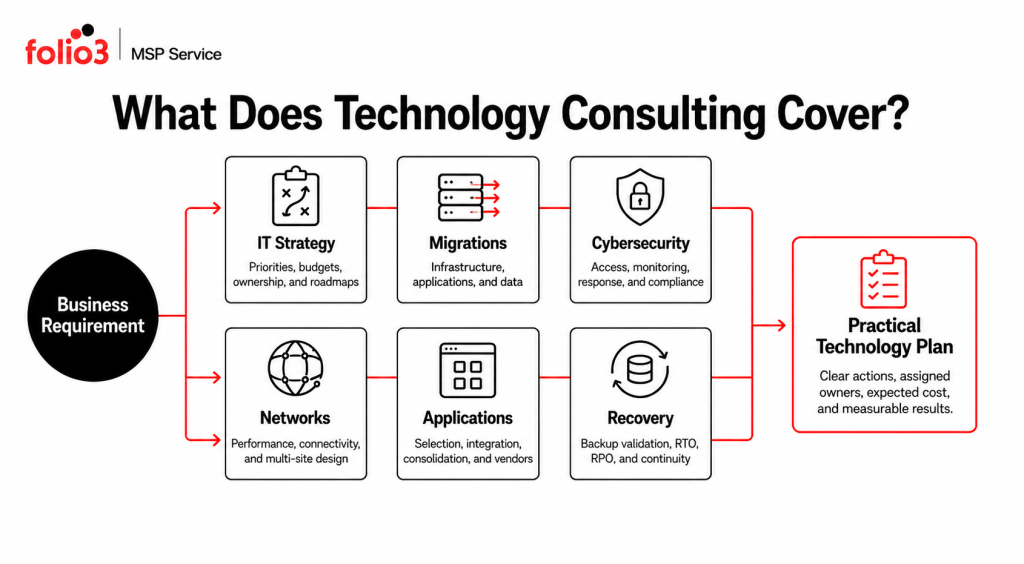
Main Types of Technology Consulting
The meaning of what is technology consulting becomes clearer when the work is separated into the problems it addresses.
IT Strategy and Technology Roadmapping
IT strategy consulting helps a business decide where technology investment should go and which work can wait.
The consultant may review current spending, operational problems, business plans, security exposure, vendor contracts, and upcoming renewals. The result is usually a phased roadmap tied to budget and business priorities.
This work is useful when technology decisions have been made department by department and the company now has overlapping applications, inconsistent ownership, or several urgent projects competing for the same budget.
Migrations Consulting
Data migration consulting covers planning, governance, cost, security, administration, migration, and ongoing operating requirements.
A consultant may review resource ownership, access, configuration, naming standards, subscriptions, storage, backups, spending, and service dependencies.
Migration consulting may also cover server and operating-system migrations, data and database migrations, application moves, email migrations, network and storage migrations, Active Directory and Microsoft Entra ID transitions, P2V, V2V and V2C virtualization moves, and complete workload or tenant migrations during mergers, acquisitions, restructuring, or platform consolidation.
Cybersecurity Consulting
Cybersecurity consulting assesses how the organization governs, prevents, detects, responds to, and recovers from security incidents.
The work may cover identity, MFA, administrative access, endpoint protection, firewalls, VPNs, migrations configuration, security monitoring, incident procedures, third-party access, and compliance requirements.
The NIST Cybersecurity Framework 2.0 organizes cybersecurity work around Govern, Identify, Protect, Detect, Respond, and Recover. The Govern function is especially relevant to consulting because it addresses ownership, policy, risk tolerance, and management oversight.
A security consultant should leave the business with priorities. A long vulnerability list without owners, deadlines, or business context creates more uncertainty.
Network and Infrastructure Consulting
Network consulting examines whether connectivity supports current users, sites, applications, calls, remote access, and future growth.
The assessment may include LAN and WAN design, wireless coverage, internet capacity, SD-WAN, routing, switching, VPNs, firewall configuration, performance monitoring, and multi-site connectivity.
This work is often triggered by recurring symptoms: dropped calls, unstable remote sessions, slow uploads, weak wireless coverage, or poor application performance at certain times.
The consultant should measure the problem. “The network feels slow” is not enough to redesign it.
Application and Vendor Consulting
Businesses often need help choosing, replacing, or consolidating applications.
A consultant can document requirements, compare vendors, assess integrations, review security and data handling, calculate ongoing operating costs, and identify migration risks.
This reduces the chance of buying a product that performs well in a demonstration but fits poorly with the company’s identity platform, data model, working practices, or support structure.
Vendor consulting can also include contract review, renewal planning, ownership mapping, and escalation procedures.
Disaster Recovery and Business Continuity Consulting
Disaster recovery consulting determines how the company will restore priority services after an outage, cyber incident, or data-loss event.
The work should define:
- Which services return first
- How long each service may remain unavailable
- How much recent data can be lost
- Where backups are stored
- Who authorizes recovery
- How restored services will be tested
- Which vendors must participate
Recovery planning needs evidence. A backup report confirms that a job ran; a restore test confirms whether the data and service can be recovered.
CISA advises businesses to maintain recovery plans and protect critical systems through measures such as MFA, software updates, incident preparation, and tested backups.
When Does a Business Need Technology Consulting?
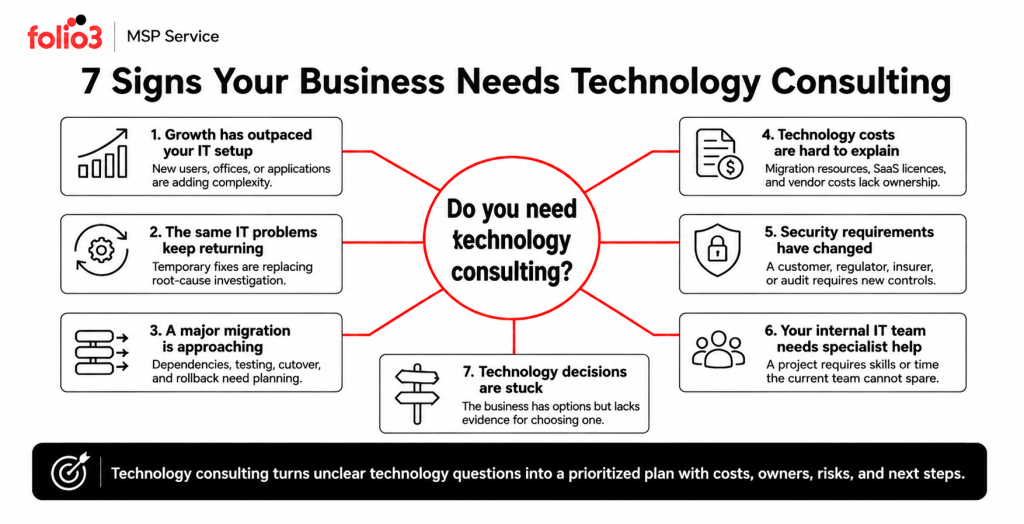
A business rarely hires a consultant because everything is running perfectly.
There is usually a trigger.
Growth Has Outpaced the Current Setup
New employees, offices, applications, and customer requirements have been added quickly. The technology environment still reflects a much smaller company.
Access becomes inconsistent. Support gets slower. Costs spread across several vendors and subscriptions.
Technology consulting helps the company decide what should be standardized before further growth makes the problem harder to untangle.
The Same IT Problems Keep Returning
Repeated incidents suggest that support is restoring service without correcting the underlying cause.
Technology consultants can review ticket patterns, monitoring data, configurations, ownership, and dependencies. The goal is to identify why the problem returns and what structural change would remove it.
A Major Migration Is Planned
Migrations carry more risk when the business has incomplete documentation.
An email migration may affect shared mailboxes, forwarding rules, archives, domain records, mobile devices, and applications that send messages. A tenant migration may involve identities, permissions, SaaS integrations, security policies, and device management.
Consulting creates the discovery, dependency, testing, cutover, and rollback plan before users are affected.
Technology Spending Is Difficult to Explain
Migrations resources, SaaS licenses, support contracts, and project costs may grow without a clear owner.
A consultant can map spending to services, departments, users, and business outcomes. This helps the business remove waste without cutting something it still needs.
Security or Compliance Requirements Have Changed
A customer contract, audit, insurer, or regulator may introduce new requirements.
Technology consulting helps translate those requirements into technical and operational work. That may include access controls, logging, incident response, vendor reviews, data protection, backup testing, and documented ownership.
The Internal IT Team Needs Specialist Support
An internal team may understand the environment well but lack time or specialist experience for a migration, security review, or a network redesign.
A consultant can provide focused support without replacing the internal team. The division of responsibility should be agreed at the beginning.
What Happens During a Technology Consulting Engagement?
The exact process depends on the problem, but the engagement should move from evidence to decision.
| Phase | What happens | Useful output |
| Discovery | Systems, users, costs, risks, vendors, and dependencies are reviewed | Current-state map |
| Analysis | Gaps and constraints are assessed against business requirements | Findings and risk register |
| Options | Feasible approaches are compared | Options paper with trade-offs |
| Roadmap | Work is prioritized around cost, risk, and dependencies | Phased implementation plan |
| Delivery support | Changes are coordinated, tested, and documented | Project records and validation |
| Review | Results are checked against the original objective | Performance and closure report |
The first phase should not be rushed.
A weak discovery process creates confident recommendations based on an incomplete environment. That is how integrations are missed, budgets expand, and cutovers run late.
What Should a Technology Consultant Deliver?
The deliverables should match the decision being made.
A typical engagement may produce:
- A current-state technology assessment
- An application and service dependency map
- A security or infrastructure risk register
- A SaaS cost review
- A target architecture
- A vendor comparison
- A migration plan
- A disaster recovery strategy
- A technology roadmap
- A budget and total-cost analysis
- A responsibility matrix
- Success measures and review dates
Avoid reports that contain dozens of recommendations with no indication of priority.
A useful report tells management what should happen first, why it matters, who owns it, what it may cost, and how the result will be checked.
How to Choose a Technology Consulting Partner
Ask how the consultant approaches diagnosis.
Do they begin by asking about business priorities, users, risks, and existing systems? Or do they lead with a platform and try to fit the problem around it?
Review the proposed deliverables closely. “Strategic recommendations” is too broad. The scope should state whether you will receive an assessment, architecture, roadmap, budget, migration plan, risk register, vendor comparison, or implementation support.
Check who will do the work. The person leading the sales call may not be the consultant assigned to the project.
Ask how disagreements will be handled. A consultant should be able to explain why an option was rejected and what evidence would change the recommendation.
Finally, confirm what happens after the report. The business may need implementation support, project governance, managed services, or a handover to its internal IT team.
How Folio3 Supports Technology Consulting and Delivery
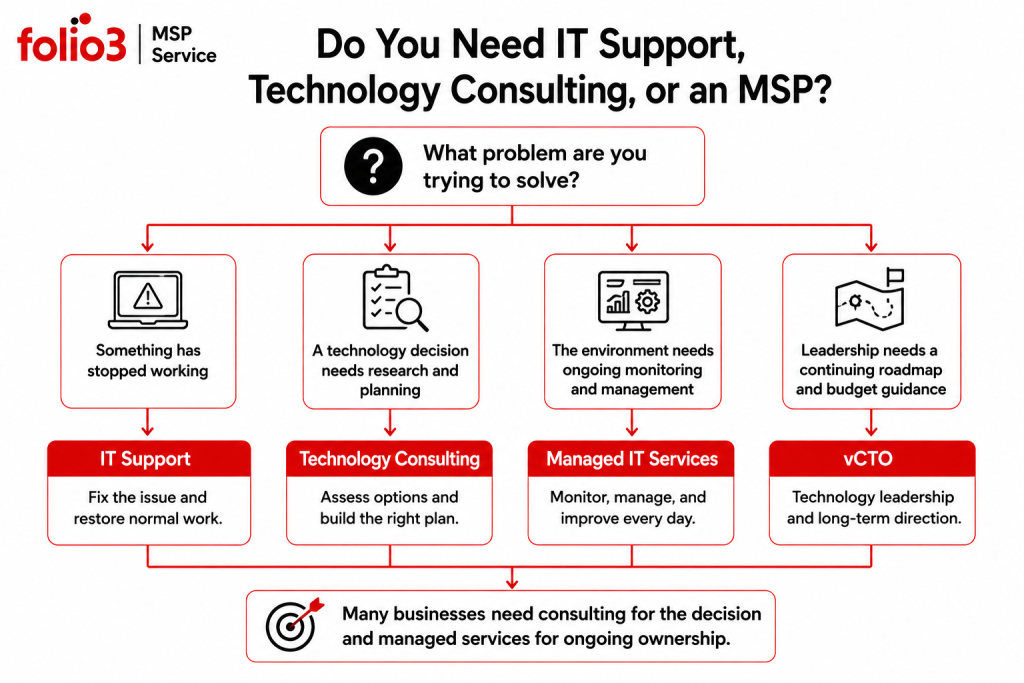
Folio3’s managed IT portfolio combines assessment, planning, implementation support, and ongoing management across six core service areas: Managed IT Support, Cybersecurity, IT Strategy and vCTO, Network and Infrastructure, and Disaster Recovery.
Managed IT Support
Folio3 supports day-to-day IT operations through proactive monitoring, helpdesk services, patch and update management, vendor coordination, escalation, and performance reporting.
Consulting findings can move into ongoing monitoring and operational ownership instead of remaining as open recommendations.
Cybersecurity
Cybersecurity services cover zero-trust planning, endpoint detection and response, firewall and VPN management, security awareness, SOC monitoring, incident response, and compliance-readiness support.
Technology consulting can define the security priorities, while the managed service maintains the controls and response process.
Data Migration
Migration support includes server and operating-system migration, data and database migration, application and email migration, network and storage migration, Active Directory and Microsoft Entra ID transitions, P2V, V2V and V2C virtualization projects, and workload or tenant migrations during consolidation, restructuring, mergers, or acquisitions.
IT Strategy and vCTO
IT Strategy and vCTO services cover technology roadmaps, budgeting, total cost of ownership, infrastructure planning, management reporting, vendor selection, and contract review.
This service is particularly relevant when the business needs continuing strategic input rather than a one-time consulting project.
Network and Infrastructure
Network consulting and management cover LAN and WAN design, SD-WAN, wireless planning, monitoring, routing, switching, firewalls, and multi-site connectivity.
The work can begin with a performance or design assessment and continue through implementation and ongoing management.
Disaster Recovery
Disaster recovery services cover backup validation, recovery targets, ransomware recovery planning, business continuity documentation, recovery exercises, and failover testing.
Consulting establishes which services need protection and how quickly they must return. Testing shows whether that plan works.
Turn Technology Questions Into Decisions
The value of technology consulting is fairly simple.
It gives the business a disciplined way to examine a problem before committing budget, changing systems, or signing another vendor contract.
Folio3 can assess the current environment, define the options, plan the work, support delivery, and manage the resulting services across IT support, cybersecurity, networks, migrations, technology strategy, and disaster recovery.
Frequently Asked Questions
Bring the current technology budget, application list, vendor details, open risks, major support issues, planned business changes, and any existing network or cloud documentation. Missing information can be identified during discovery.
A focused assessment may take a few weeks, while a multi-site strategy, migration, or security program can take several months. The timeline depends on scope, access to evidence, stakeholder availability, and the number of systems involved.
It can. Some engagements end with a roadmap, while others include project planning, migration delivery, vendor coordination, testing, and post-change review. The scope should state exactly where the consultant’s responsibility ends.
The recommendation should be based on the business requirement and current environment. A consultant with vendor partnerships should disclose them and explain why the proposed platform is a better fit than the alternatives.
Yes. In fact, an assessment is often most useful before budget decisions are finalized. It can separate urgent risk, mandatory work, planned improvement, and optional investment.
A useful report includes priorities, owners, dependencies, cost ranges, target dates, and expected outcomes. A document that only lists problems leaves the hardest decisions with the customer.