
Hiring a Chief Information Officer (CIO) isn’t a decision most businesses make overnight. It usually comes after a series of technology challenges that start small but become harder to ignore.
Cybersecurity projects keep getting pushed back because the IT team is busy handling support tickets. Every department wants new software, yet no one is evaluating whether those tools fit into a long-term technology strategy.
These aren’t technical problems alone, they’re leadership problems.
Many growing companies reach a stage where they need someone to answer bigger questions:
- Which technology investments will actually support growth?
- Are we spending our IT budget in the right places?
- Is our infrastructure ready for AI, automation, or expansion?
- How do we reduce cybersecurity risks without overspending?
- Which vendors should we trust?
Large enterprises often solve these challenges by hiring a full-time CIO. For many small and mid-sized businesses, however, that isn’t always practical. A permanent executive brings significant costs and may not be fully utilized if the organization doesn’t require day-to-day executive oversight.
That’s where a Virtual CIO fits in.
A Virtual CIO gives businesses access to executive-level technology leadership on a flexible basis. Instead of managing password resets or troubleshooting laptops, they focus on long-term planning, governance, technology investments, cybersecurity, and digital transformation.
The question isn’t whether one role is better than the other. It’s which one matches the way your business operates today, and where you expect it to be in the next three to five years.
This guide explains the differences, outlines what Virtual CIO consulting services typically include, and provides a framework for deciding which model is the right fit.
What Is a Virtual CIO?
A Virtual CIO (vCIO) is an external technology executive who works with your leadership team to shape business technology strategy.
Unlike traditional IT support providers that focus on keeping systems running, a Virtual CIO focuses on helping the business make better technology decisions. Their work often begins long before new hardware is purchased or software is deployed.
A typical engagement might involve questions such as:
- Should we move to Microsoft Azure or continue investing in on-premises infrastructure?
- Is our cybersecurity budget aligned with the risks we face?
- Can AI automate repetitive workflows without creating compliance issues?
- Which systems should be replaced first, and which can wait another year?
- Are our technology investments supporting the company’s growth plans?
Those decisions affect budgets, productivity, security, and customer experience. They also require someone who understands both technology and business strategy.
A Virtual CIO works alongside executives, finance leaders, and IT managers to provide that perspective without becoming another full-time executive on payroll.
What Does a Full-Time CIO Do?
A full-time Chief Information Officer has broader operational responsibilities.
In addition to setting technology strategy, they typically oversee internal IT departments, manage large teams, approve enterprise-wide technology investments, report to executive leadership, and guide major transformation initiatives across the organization.
Their day often includes:
- Leading infrastructure and application teams
- Reviewing cybersecurity risks
- Managing enterprise technology budgets
- Meeting with department heads to align technology priorities
- Overseeing large-scale modernization projects
- Reporting technology performance to executive leadership or the board
For organizations operating across multiple regions or supporting thousands of employees, this level of involvement makes sense.
For a business with a lean IT team, however, many of those responsibilities don’t require a dedicated executive working forty or more hours every week.
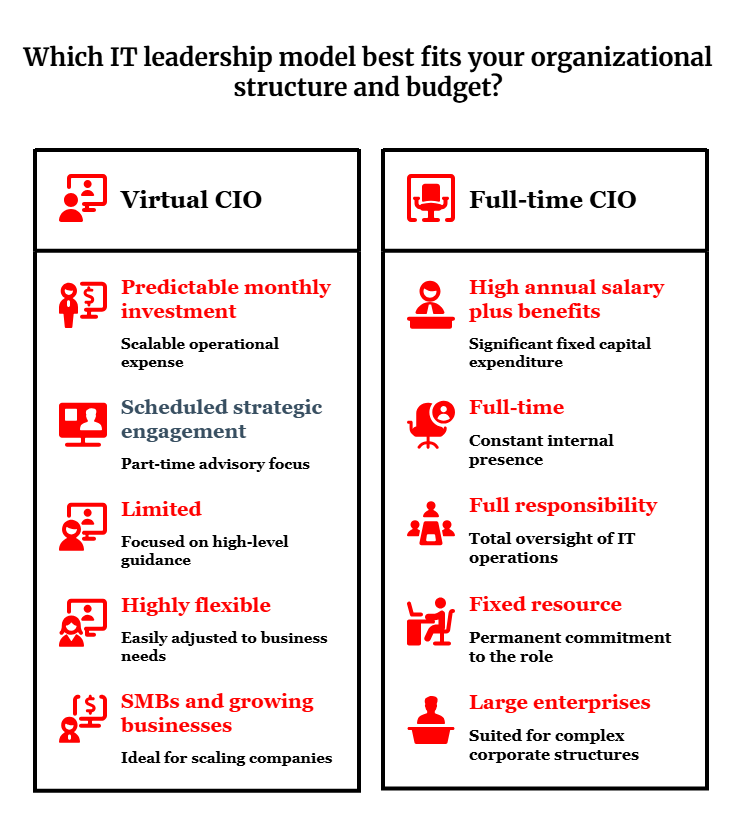
Virtual CIO vs Full-Time CIO
The biggest difference isn’t expertise. It’s how that expertise is delivered.
Both roles are expected to think strategically, reduce technology risks, and support business growth. The distinction lies in how much executive involvement your organization actually needs.
Imagine two companies.
The first is a regional logistics company with 120 employees. Its IT department consists of a help desk technician, a systems administrator, and an infrastructure manager. The business is planning to expand into two new locations, migrate to Microsoft 365, and improve cybersecurity after failing a customer security assessment.
Hiring a permanent CIO would likely leave that executive underutilized for much of the year.
Now consider a multinational manufacturer with thousands of employees, multiple data centers, several software development teams, and strict regulatory requirements across different countries.
That organization benefits from having a CIO involved in executive decisions every day.
The role hasn’t changed. The scale of the business has.
Understanding where your organization sits on that spectrum is usually the first step in deciding whether a Virtual CIO or a full-time CIO makes more sense.
What Do Virtual CIO Consulting Services Include?
One of the reasons businesses hesitate to hire a Virtual CIO is that the role sounds broad. Unlike managed IT services, where the deliverables are usually easy to define ;like help desk support, server maintenance, or network monitoring, a Virtual CIO works at the strategic level.
The value comes from helping the business make better technology decisions before expensive problems appear.
Here’s what that typically looks like.
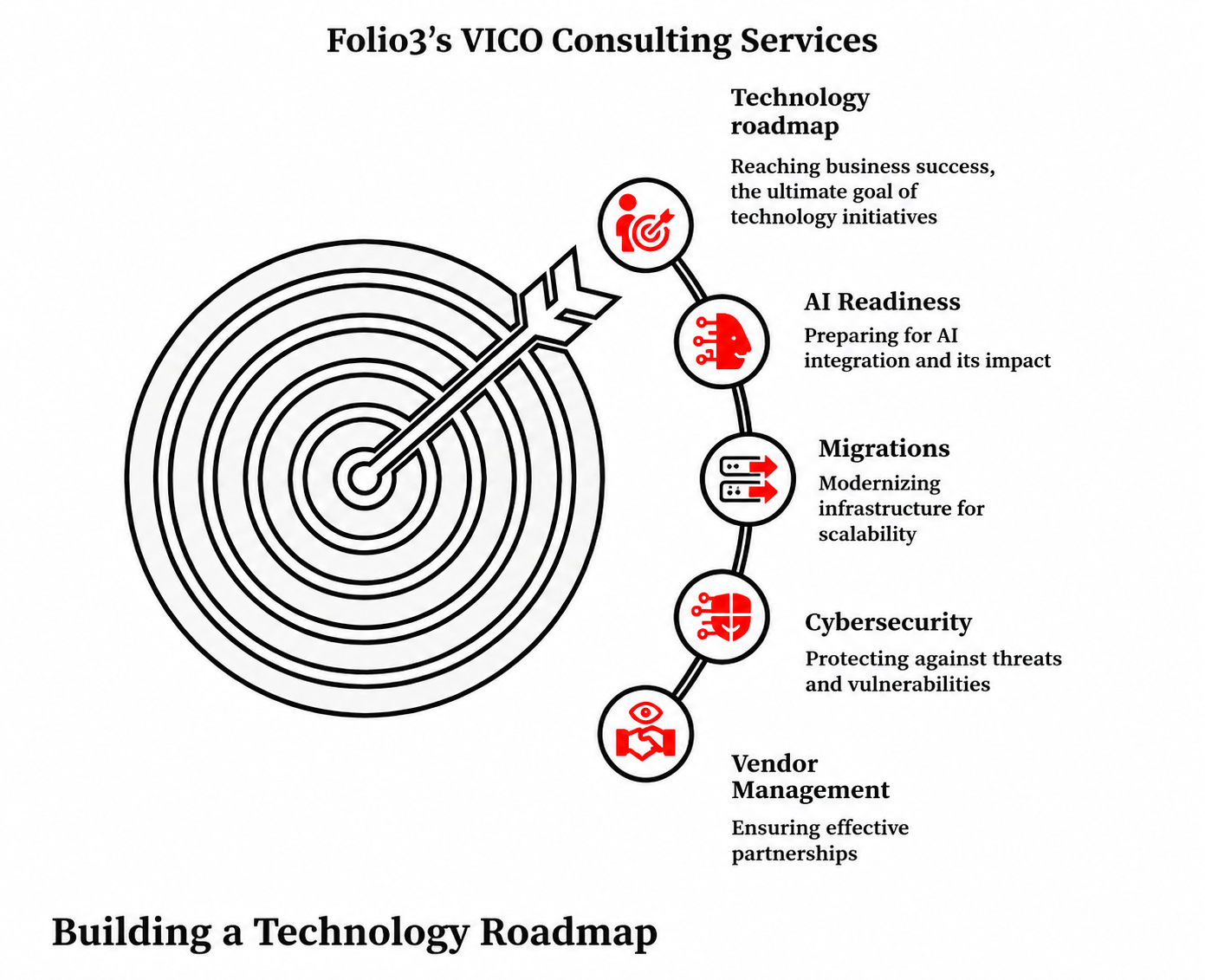
Building a Technology Roadmap
Most companies have a list of technology projects. Fewer have a roadmap.
There’s a difference.
A project answers, “What do we need to do next?” A roadmap answers, “What should we do over the next three years, and in what order?”
For example, a company planning to introduce AI-powered customer support might assume it needs to buy an AI platform first. A Virtual CIO would usually ask different questions:
- Is your customer data accurate enough to train AI models?
- Can your current CRM integrate with AI tools?
- Are there governance policies for AI-generated content?
- Does your security program cover AI applications?
Those answers determine whether AI should be this year’s priority or next year’s.
A roadmap helps leadership invest in technology at the right time instead of chasing every new trend.
Aligning IT Spending With Business Priorities
Technology budgets often grow one purchase at a time.
A department requests new software. Infrastructure needs replacing. Security licenses renew.
After a few years, many organizations struggle to explain where the IT budget is actually going.
A Virtual CIO reviews spending across the business and asks questions such as:
- Which applications are rarely used?
- Are different teams paying for similar tools?
- Which systems create the highest operational risk?
- Which investments directly support business growth?
That review often identifies opportunities to reduce unnecessary software costs while redirecting investment toward projects that improve productivity, security, or customer experience.
The goal isn’t simply to spend less. It’s to spend with purpose.
Strengthening Cybersecurity Before Problems Escalate
Cybersecurity planning shouldn’t begin after a failed audit or a ransomware attack.
A Virtual CIO evaluates how security fits into the wider business strategy by reviewing areas such as:
- Identity and access management
- Multi-factor authentication
- Backup and disaster recovery
- Endpoint protection
- Security awareness training
- Vendor security requirements
- Incident response planning
- Regulatory compliance obligations
Suppose your sales team starts using a new CRM that stores customer information in another country. That’s no longer just an IT decision. It affects data privacy, compliance obligations, vendor risk, and contract negotiations.
A Virtual CIO connects those dots before they become business problems.
Planning Migration and Technology Modernization
Migration is no longer about simply moving every workload to a new environment. The real challenge is deciding what should move, what should be modernized, and how each change supports business goals.
A structured migration strategy evaluates:
- Which workloads are ready for migration
- Which applications require modernization before moving
- Which systems should remain on-premises
- How dependencies, security, and compliance requirements will be handled
- How costs and performance will be managed after migration
- Whether backup and disaster recovery plans support the new environment
Instead of migrating everything at once, organizations can prioritize business-critical workloads, validate the approach, and expand migration efforts based on measurable results.
This approach reduces disruption, improves cost visibility, and helps businesses build a more reliable and scalable technology environment.
Preparing the Business for AI
Many executives are under pressure to “do something with AI.”
The challenge is deciding what that something should be.
A Virtual CIO helps separate practical opportunities from expensive experiments by assessing:
- Data quality and availability
- Existing business processes
- Privacy and compliance requirements
- Infrastructure readiness
- Employee adoption
- Governance policies
For one organization, AI might reduce the time spent processing invoices. For another, it could improve customer support through an internal knowledge assistant. In both cases, the starting point is the business problem, not the technology.
Managing Technology Vendors
Every vendor promises lower costs, better security, or improved productivity.
Sorting marketing claims from genuine business value takes time and experience.
A Virtual CIO acts as an independent advisor during vendor evaluations by:
- Reviewing technical proposals
- Comparing competing solutions
- Assessing implementation risks
- Identifying hidden licensing costs
- Negotiating renewals where appropriate
- Confirming compatibility with existing systems
This becomes particularly valuable during ERP implementations, data migrations, cybersecurity projects, or software procurement, where long-term costs often exceed the initial purchase price.
When a Virtual CIO Makes the Most Sense
A Virtual CIO isn’t simply the lower-cost alternative to a full-time executive. It’s often the better operational model for organizations that need strategic guidance but don’t have enterprise-scale technology operations.
You should consider a Virtual CIO if your business is experiencing situations like these:
- Your IT team spends most of its time solving day-to-day issues instead of planning ahead.
- Technology decisions are being made department by department without a long-term strategy.
- You’re preparing for rapid growth, acquisitions, or expansion into new markets.
- Cybersecurity has become a board-level discussion, but no one owns the overall strategy.
- Software costs continue to increase, yet it’s difficult to measure business value.
These are leadership gaps rather than technical gaps. Bringing in strategic guidance early often prevents costly mistakes later.
Why Choose Folio3’s Virtual CIO Consulting Services?
Technology decisions affect every part of your business, from security and productivity to operating costs and future growth. Our Virtual CIO consulting services help you make those decisions with a clear strategy instead of reacting to day-to-day challenges.
Whether you’re scaling your business, replacing legacy systems, or planning your next major IT investment, our Virtual CIOs help you make informed decisions that support long-term growth.
What You Can Expect from Folio3’s Virtual CIO Services
Business-First Technology Strategy
We develop technology roadmaps that directly support your business objectives, ensuring every IT initiative contributes to measurable outcomes.
Executive-Level Technology Leadership
Gain access to experienced technology advisors without the cost of hiring a full-time CIO. We provide strategic guidance on technology planning, digital transformation, cybersecurity, and IT governance.
AI Readiness and Transformation Planning
From identifying practical AI use cases to evaluating infrastructure and governance requirements, we help your organization prepare for responsible AI adoption.
Migration Optimization and Modernization
Whether you are planning a migration or improving an existing environment, optimization is essential to ensure workloads remain secure, efficient, and aligned with business needs.
Cybersecurity Strategy and Risk Management
Our experts help strengthen your security posture through strategic planning, governance frameworks, risk assessments, compliance guidance, and incident preparedness.
Vendor-Neutral Technology Recommendations
We provide objective advice based on your business goals, not vendor incentives helping you select the right technologies and maximize return on investment.
IT Budgeting and Financial Planning
We create predictable IT budgets, prioritize technology investments, and help eliminate unnecessary spending while planning for future growth.
Technology Governance and Executive Reporting
Stay informed with regular technology reviews, executive reporting, KPI tracking, and governance frameworks that improve visibility and accountability.
Long-Term Strategic Partnership
Technology isn’t static, and neither is your business. Our Virtual CIOs provide ongoing strategic guidance to help your technology evolve as your organization grows.
Frequently Asked Questions
A Virtual CIO (vCIO) is an outsourced technology executive who provides strategic IT leadership on a flexible basis. They help businesses develop technology strategies, manage IT budgets, strengthen cybersecurity, oversee digital transformation, and ensure technology investments support business goals without the cost of hiring a full-time CIO.
Both roles perform similar strategic functions, but a Virtual CIO works as an external advisor on a part-time or subscription basis, while a full-time CIO is a permanent executive responsible for day-to-day leadership of an organization’s technology operations and internal IT teams.
A Virtual CIO is ideal for small and mid-sized businesses, growing organizations, and companies undergoing digital transformation that need executive technology leadership but don’t require or can’t justify the cost of a full-time CIO.
Virtual CIO consulting services typically include; Technology strategy and roadmap development, IT budgeting and financial planning, Cybersecurity strategy, Cloud planning and optimization, Digital transformation leadership, AI readiness assessments, Vendor management, Technology governance, Risk management, and Executive technology advisory.
No. While many small and medium-sized businesses benefit from Virtual CIO services, larger organizations also use Virtual CIOs for strategic projects, mergers and acquisitions, digital transformation initiatives, or to supplement internal leadership.
Yes. A Virtual CIO develops cybersecurity strategies, performs risk assessments, recommends security improvements, supports compliance initiatives, and helps create incident response and business continuity plans to strengthen your organization’s overall security posture.
A Virtual CIO evaluates existing technologies, identifies opportunities for modernization, develops transformation roadmaps, oversees cloud migration, recommends automation solutions, and ensures technology initiatives align with long-term business objectives.
Absolutely. A Virtual CIO can assess your organization’s AI readiness, identify high-value use cases, establish governance frameworks, evaluate infrastructure requirements, and guide responsible AI implementation while managing associated risks.
The level of engagement depends on business requirements. Some organizations meet weekly, while others schedule monthly strategic reviews or receive ongoing advisory support based on active projects and technology priorities.
If your business lacks a long-term IT strategy, struggles with technology planning, faces growing cybersecurity concerns, wants to modernize its infrastructure, or needs executive technology guidance without hiring a full-time CIO, a Virtual CIO is likely the right solution.